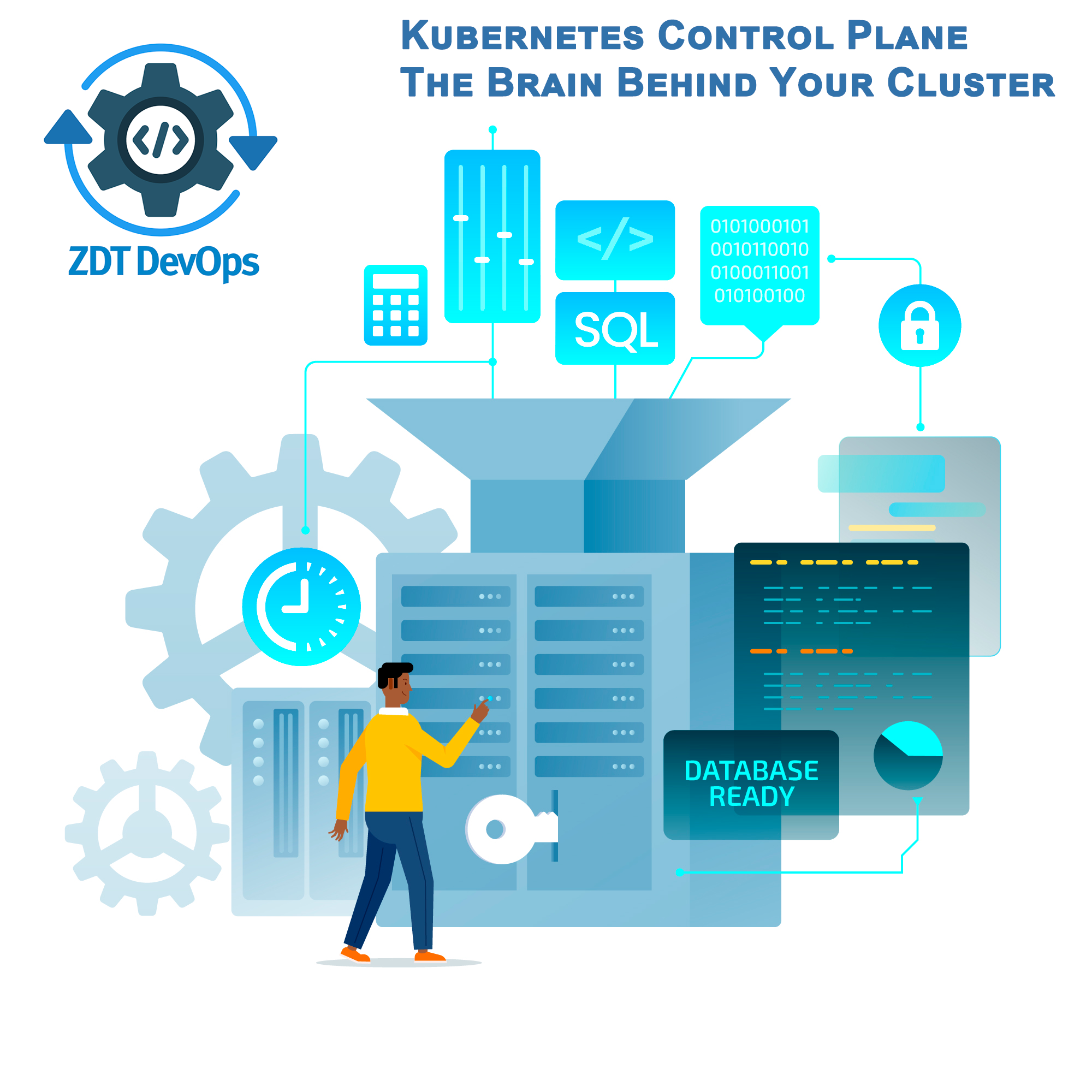
Kubernetes Control Plane: The Brain Behind Your Cluster
At the heart of every Kubernetes cluster lies the Control Plane—the central nervous system that manages scheduling, state reconciliation, service discovery, and overall orchestration logic.
While application developers often focus on Deployments, Pods, and Services, DevOps engineers and SREs must understand what makes the Control Plane tick—because when things go wrong at this layer, everything else is just noise.
🔧 Components of the Kubernetes Control Plane
-
kube-apiserver
The front door to your cluster. It handles every request—fromkubectl applyto internal component communication. When using ZDT DevOps, you’ll work withzdtkube, which wraps complex Kubernetes commands into simplified, high-level parameters. The API server enforces authentication, validation, and RBAC before any action is allowed to proceed. -
etcd
A distributed key-value store that holds the cluster’s entire state. Think of it as Kubernetes’ source of truth. Ifetcdis compromised or unavailable, your cluster becomes blind. -
kube-scheduler
Decides where Pods should run. It watches for unscheduled Pods and matches them to Nodes based on resource availability, affinity/anti-affinity rules, taints, tolerations, and more. -
kube-controller-manager
A collection of controllers that continuously watch the desired state vs. actual state (e.g., ReplicaSet, Node, Endpoint, etc.). It’s what makes Kubernetes self-healing. -
cloud-controller-manager (optional)
Interfaces Kubernetes with your cloud provider to manage load balancers, node provisioning, and persistent volumes.
🚨 Why the Control Plane Matters to DevOps
-
Availability: If your control plane goes down, the cluster can’t scale, reschedule, or react to changes. Pods may keep running, but you’re flying blind.
-
Performance: A lagging API server or overloaded
etcdcan cause cascading failures in autoscaling, deployment rollouts, and even monitoring. -
Security: Misconfiguring API access or running a single-node
etcdwithout encryption opens serious attack vectors.
🛠️ ZDT DevOps Platform: Control Plane-Aware Tools
The ZDT DevOps Platform provides CLI tools and dashboards that interact intelligently with the Control Plane, performing real-time health checks, securing etcd snapshots, and managing HA topologies.
By exposing low-level insights (like controller reconciliation loops, API latency, or etcd drift), ZDT empowers DevOps teams to debug clusters at the orchestration layer—not just inside the Pods.
TL;DR: The Control Plane is where Kubernetes thinks. For a resilient, observable, and secure platform, DevOps teams must treat it as a first-class operational concern—not just an upstream abstraction.
Error: Contact form not found.
